
The Art of Visual Harmony: Mastering Gestalt Principles
- Jo Ionescu

- May 27, 2023
- 3 min read

The Gestalt principles, deeply rooted in psychology and perception, have had a profound impact on various fields of study, including design and visual aesthetics. Developed by a group of German psychologists in the early 20th century, the Gestalt school of thought emerged as a powerful framework for understanding how humans perceive and organize visual information.
The term "Gestalt" originates from the German word meaning "shape" or "form." The pioneers of Gestalt psychology, such as Max Wertheimer, Wolfgang Köhler, and Kurt Koffka, sought to explore how the human mind perceives and makes sense of the world around us. Their work challenged the prevailing reductionist approach in psychology (an approach centered on the belief that we can best explain something by breaking it down into its individual parts) at the time, which focused on breaking down experiences into isolated elements.
The Gestalt psychologists proposed that perception is not just a simple summation of individual parts, but rather a holistic and organized interpretation of sensory stimuli. They emphasized the idea that the whole is greater than the sum of its parts. To understand this concept, they conducted experiments that demonstrated how people perceive visual patterns and how our brains naturally seek structure and coherence in the environment.
From these experiments and observations, the Gestalt principles gradually took shape. These principles aimed to explain the fundamental ways in which humans perceive and organize visual elements. Some of the key principles that emerged include the laws of proximity, similarity, closure, continuity, figure/ground, symmetry, and common fate.
Over time, these principles found practical applications in various fields, including art, design, and, most notably, UX/UI design. Designers recognized the power of Gestalt principles in creating visually appealing and user-friendly interfaces.
By understanding how users perceive and interpret visual stimuli, designers could leverage these principles to guide attention, create hierarchy, establish relationships between elements, and evoke desired emotions or responses. And here we are talking about the human tendency to seek patterns, structure, and coherence in the environment.
Today, the Gestalt principles remain foundational in the world of design. They serve as guiding principles for designers to create intuitive, cohesive, and aesthetically pleasing experiences. By applying these principles, designers can optimize user interfaces, improve usability, and ensure that visual elements are organized in a way that aligns with human perception and cognition.
Let's see a few of the principles and how they work:
Law of Proximity: When elements are close to one another, we naturally perceive them as a cohesive group. In UX/UI design, this principle is invaluable for visually grouping related items, such as navigation links or options within a form.

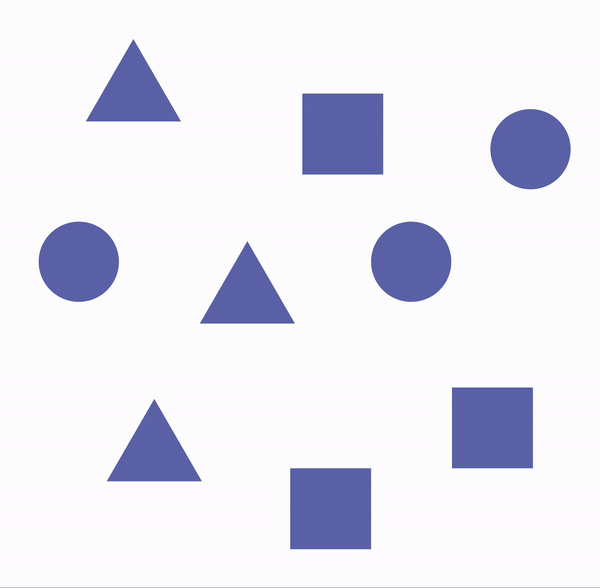
Law of Similarity: Elements sharing visual attributes like shape, color, or size are perceived as belonging together. This principle enables designers to differentiate or group similar items effectively, like buttons with similar functions.

Law of Closure: Our minds tend to fill in missing parts to perceive incomplete objects as complete. In UI design, this principle can be leveraged to create simplified icons or illustrations where users intuitively understand the intended object or shape despite lacking certain details.

Law of Continuity: Smooth, continuous lines or curves are perceived as belonging together. UX/UI designers utilize this principle to guide users' eyes along desired paths or create a sense of flow between different sections or components.

Law of Figure/Ground: Our brains naturally separate objects into the foreground (figure) and background (ground). This principle aids in creating a visual hierarchy, making important elements stand out from the background or clearly distinguishing content from surrounding whitespace.

Law of Symmetry: Symmetrical objects are perceived as visually appealing and harmonious. In UI design, symmetry can be utilized to create balanced layouts or emphasize key elements by placing them at the center or using symmetrical arrangements.

Law of Common Fate: Elements moving or changing together are perceived as related or belonging to a group. In UI design, this principle facilitates the creation of animations or transitions that connect related elements or demonstrate the relationship between different states.
From a psychological standpoint, we possess inborn tendencies and cognitive processes that influence how we interpret and make sense of the visual world around us.
The Gestalt principles provide valuable insights into how our brains naturally organize and perceive visual information. They shed light on the underlying mechanisms that shape our understanding and help designers create interfaces that align with these cognitive processes. By leveraging these principles, designers can enhance user experiences by tapping into users' natural inclinations.
The significance of Gestalt principles in design lies in their ability to bridge the gap between human psychology and user interfaces. By considering how humans naturally perceive and organize visual information, designers can create designs that resonate with users, fostering positive experiences and forging a deeper connection between users and the digital products they interact with.


Comments